
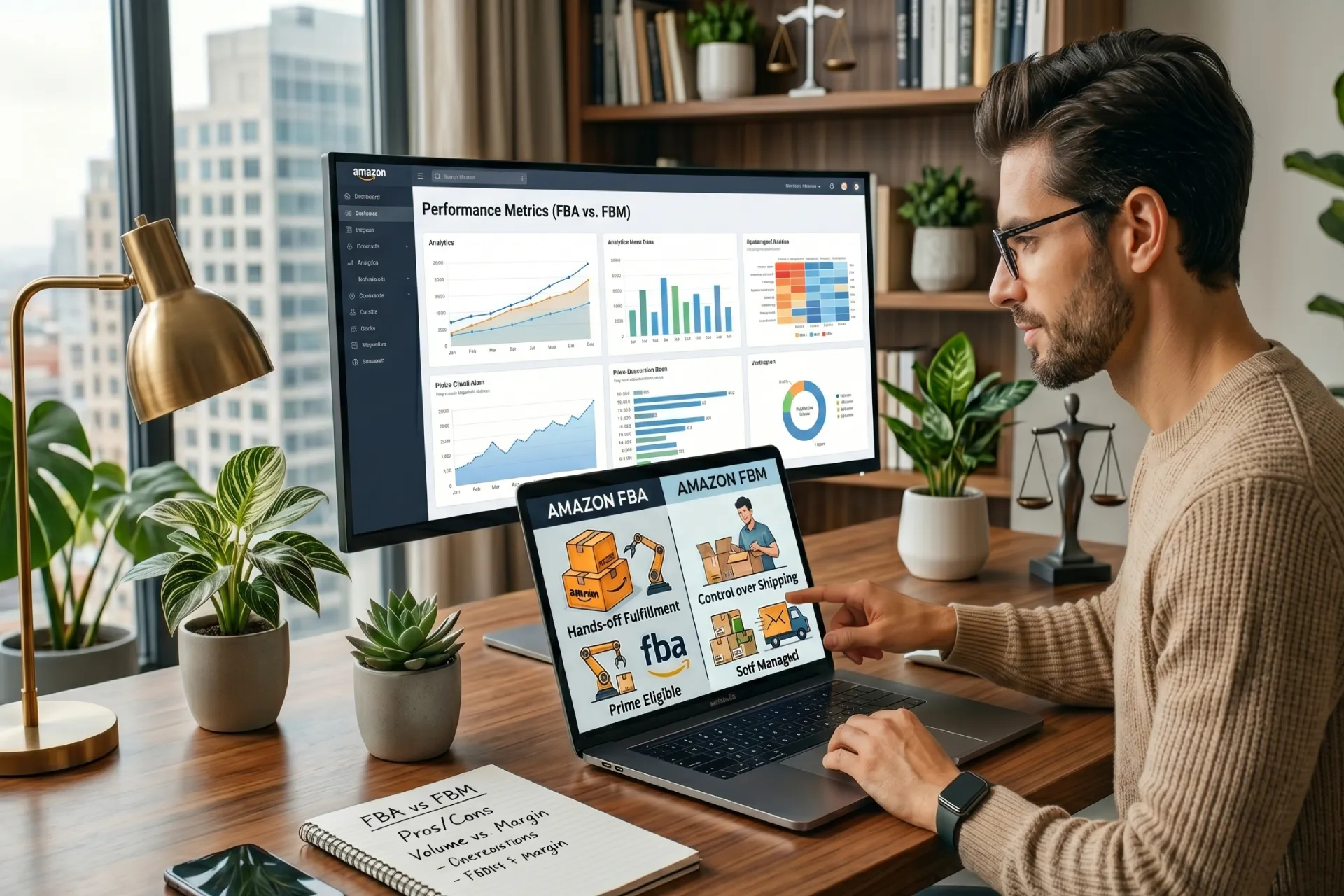
Side-by-Side Comparison
| Factor | FBA | FBM |
|---|---|---|
| Fulfillment | Amazon picks, packs, ships | You (or your 3PL) picks, packs, ships |
| Prime eligibility | Automatic | Only with Seller Fulfilled Prime (SFP) — strict requirements |
| Customer service | Amazon handles | You handle |
| Returns | Amazon processes | You process |
| Storage | Amazon’s warehouses (monthly fees) | Your warehouse (your rent/overhead) |
| Buy Box advantage | Strong | Moderate to weak |
| Conversion rate | Higher (Prime badge + trust) | Lower (no Prime for most FBM) |
| Per-unit cost | FBA fee ($3.06-$10+) | Shipping cost + labor + packaging ($2-$8+) |
| Control over shipping | None (Amazon decides carrier, packaging) | Full control (carrier, packaging, inserts, branding) |
| Scalability | Infinite (Amazon’s infrastructure) | Limited by your warehouse/3PL capacity |
| Brand experience | Amazon-branded packaging | Your branded packaging (if desired) |
The FBA Advantage: Why Most Sellers Should Start Here
The Prime Conversion Premium
FBA products are automatically Prime-eligible. The Prime badge is the most powerful conversion signal on Amazon. Prime members (200+ million in the US) filter for Prime-eligible products and trust the 1-2 day delivery guarantee.
The conversion impact: FBA products convert at 2-3x the rate of non-Prime FBM products for the same listing. This isn’t a marginal difference — it’s transformational. A product converting at 12% (FBA) versus 5% (FBM) generates 2.4x more sales from the same traffic.
This conversion premium also affects PPC efficiency: every ad click to an FBA listing is worth more because a higher percentage convert to purchases, reducing your effective cost per acquisition.
Buy Box Dominance
Amazon’s Buy Box algorithm heavily favors FBA offers. When competing against FBM sellers at similar price points, FBA sellers win the Buy Box the vast majority of the time. And without the Buy Box, you can’t run advertising. See: Amazon Buy Box Guide →
Operational Simplicity
FBA eliminates: warehouse management, order picking and packing, carrier negotiations, shipping label generation, delivery tracking, customer service for shipping issues, and returns processing. You ship bulk inventory to Amazon. They handle the rest.
For brands focused on product development, marketing, and growth — rather than logistics operations — FBA frees enormous operational capacity.
Multi-Channel Fulfillment
Amazon’s FBA can also fulfill orders from your Shopify store, Walmart marketplace, and other channels through Multi-Channel Fulfillment (MCF). One inventory pool in FBA serves all your sales channels.
The FBM Advantage: When It Makes Sense
Lower Costs for Specific Product Types
FBA fees are based on size and weight. For heavy, oversized, or bulky products, FBA fees can consume 25-40% of the selling price — making profitability nearly impossible.
Example — heavy product:
| Cost Component | FBA | FBM |
|---|---|---|
| Product: 15 lb home goods item, selling at $65 | ||
| FBA fulfillment fee | $12.78 | — |
| FBA storage (monthly, oversized) | $1.80 | — |
| FBM shipping (negotiated UPS rate) | — | $8.50 |
| FBM labor + packaging | — | $2.00 |
| Total fulfillment cost | $14.58 | $10.50 |
| Savings with FBM | $4.08/unit |
At 500 units/month, that’s $2,040/month in savings — significant for a product with moderate margins.
Full Control Over Customer Experience
FBM allows branded packaging, custom inserts, handwritten thank-you notes, and gift wrapping options that FBA doesn’t support. For premium brands where the unboxing experience is part of the value proposition, FBM preserves that touchpoint.
No Storage Fee Exposure
FBA storage fees compound for slow-moving inventory. Products sitting in Amazon warehouses for 6+ months incur aged inventory surcharges ($1.50-$7.50+ per cubic foot). FBM eliminates this risk entirely — you store inventory on your own terms.
Better for Fragile or Customized Products
Products requiring special handling (fragile items, personalized/customized products, products requiring assembly before shipping) are better suited to FBM where you control the fulfillment process.
The Decision Framework
Choose FBA If:
- Your product is standard-size (under 20 lb, fits in standard packaging)
- Your selling price supports FBA fees with 20%+ net margin remaining
- You sell 100+ units per month (fast-moving inventory avoids storage surcharges)
- You don’t have existing fulfillment infrastructure
- Conversion rate and Buy Box advantage are critical (competitive category)
- You want Prime eligibility without meeting SFP requirements
Choose FBM If:
- Your product is heavy (15+ lb) or oversized (longest side 18+ inches)
- FBA fees consume more than 20% of your selling price
- Your product sells slowly (under 50 units/month — storage fees accumulate)
- You already have a warehouse or 3PL with competitive shipping rates
- Your brand experience requires custom packaging or handling
- Your product requires customization or special prep before shipping
- Your product is fragile and requires packaging control
Consider the Hybrid Model:
Many successful sellers use both: FBA for fast-selling, standard-size products (the 80% of revenue), and FBM for slow-moving, oversized, or specialized products (the 20%). This captures FBA’s conversion advantage where it matters most while avoiding FBA’s cost disadvantage where it hurts most.
Seller Fulfilled Prime (SFP): The Middle Ground
SFP lets you offer Prime shipping on FBM orders — getting the Prime badge without sending inventory to Amazon’s warehouses. But the requirements are strict:
SFP requirements:
- 99% on-time shipment rate
- Less than 0.5% cancellation rate
- Use Amazon Buy Shipping for at least 99% of orders
- Deliver within 1-2 business days to the customer
- Saturday and Sunday shipping capability
- Support for Amazon’s returns policy
- Trial period to prove performance before full enrollment
Reality check: SFP requirements are extremely demanding. The 1-2 day delivery window to the entire US requires either: multiple warehouse locations across the country, or partnership with a carrier that guarantees 1-2 day delivery from a single location (expensive). Most sellers who attempt SFP either fail the trial or find the logistics cost comparable to FBA — negating the cost advantage.
Our recommendation: SFP makes sense only if you already have a multi-location fulfillment network or a 3PL with national 1-2 day coverage. For everyone else, FBA provides Prime eligibility with less operational complexity.
Cost Comparison Calculator
Use this framework to compare FBA vs FBM for your specific product:
FBA Total Cost per Unit:
FBA Fulfillment Fee (based on size/weight tier)
+ Monthly Storage Fee (based on cubic feet × months in warehouse)
+ Potential Aged Inventory Surcharge (if slow-selling)
+ Inbound Shipping to FBA (your cost to ship bulk to Amazon)
= Total FBA Cost per Unit
FBM Total Cost per Unit:
Outbound Shipping Cost (per order, based on weight and destination)
+ Packaging Materials ($0.50-$2.00 per order)
+ Labor (picking, packing — $1.00-$3.00 per order depending on complexity)
+ Warehouse Cost (rent ÷ units stored — allocated per unit)
+ Customer Service Time (allocated per order)
= Total FBM Cost per Unit
Then compare: If FBA cost is lower AND you get the Prime conversion premium, FBA wins decisively. If FBM cost is lower, calculate the conversion rate impact: FBM at $5 less per unit but 50% fewer sales may not be a net benefit.
The breakeven question: How much additional sales volume does FBA’s Prime badge need to generate to offset FBA’s higher per-unit cost? If FBA costs $4 more per unit but generates 2x the sales, FBA produces more total profit despite higher per-unit cost.
Switching Between FBA and FBM
Moving from FBM to FBA
- Create a shipping plan in Seller Central for your existing FBM inventory
- Prep and label units according to Amazon’s FBA requirements
- Ship inventory to assigned fulfillment centers
- Once received, your listing automatically updates to FBA/Prime eligible
- Monitor the conversion rate change — expect a significant jump within 1-2 weeks
Moving from FBA to FBM
- Set up your FBM shipping settings in Seller Central
- Create a removal order for your FBA inventory (Amazon ships it back to you)
- Switch the listing fulfillment channel from FBA to FBM
- Begin fulfilling orders from your own warehouse/3PL
- Monitor conversion rate — expect a decline. Factor this into your profitability calculation.
Transition risk: Switching from FBA to FBM mid-selling season can disrupt organic ranking. The conversion rate drop reduces sales velocity, which can lower organic position. Time the switch during a low-sales period if possible, and have strong advertising in place to maintain velocity during the transition.
Frequently Asked Questions
Is FBA always more expensive per unit than FBM?
No. For lightweight, standard-size products, FBA is often comparable to or cheaper than FBM when you account for the full FBM cost (shipping, labor, packaging, warehouse). FBA becomes more expensive for heavy and oversized items where the FBA fee scales steeply with weight.
Can I use FBA for some products and FBM for others?
Yes. This hybrid approach is common and recommended. Use FBA for your best-sellers and standard-size products. Use FBM for oversized, slow-moving, or specialized products. You manage both simultaneously in Seller Central.
Does FBM affect my ability to run ads?
You can run Sponsored Products ads with FBM listings — but only if you hold the Buy Box. FBM sellers have a harder time winning the Buy Box against FBA competitors, which means your ad eligibility may be intermittent. FBA provides more consistent Buy Box ownership and therefore more consistent ad delivery.
What about Amazon’s returns processing?
FBA returns are handled entirely by Amazon — the customer initiates a return, Amazon processes it, and your account is debited the applicable fees. FBM returns require you to provide a return address, accept the shipment, inspect the product, and process the refund. FBM returns are more labor-intensive but give you more control over the inspection process.
How do I decide for a new product with no sales data?
Default to FBA for the launch phase. FBA’s conversion advantage is most critical during a product launch when you need maximum sales velocity to build organic ranking. After 90 days, evaluate the unit economics: if FBA is significantly more expensive than FBM for your specific product AND you’ve built enough organic ranking to sustain sales without the Prime badge, consider switching to FBM.
Next Steps
Not sure which model fits your products? Our free audit includes a fulfillment cost comparison showing the FBA vs FBM economics for your specific catalog. Get your free audit →
Keep reading:
- Amazon FBA Fees 2026: Complete Cost Breakdown →
- Amazon Buy Box: How to Win It and Keep It →
- How Much Does It Cost to Sell on Amazon? →
Last Updated: March 2026